
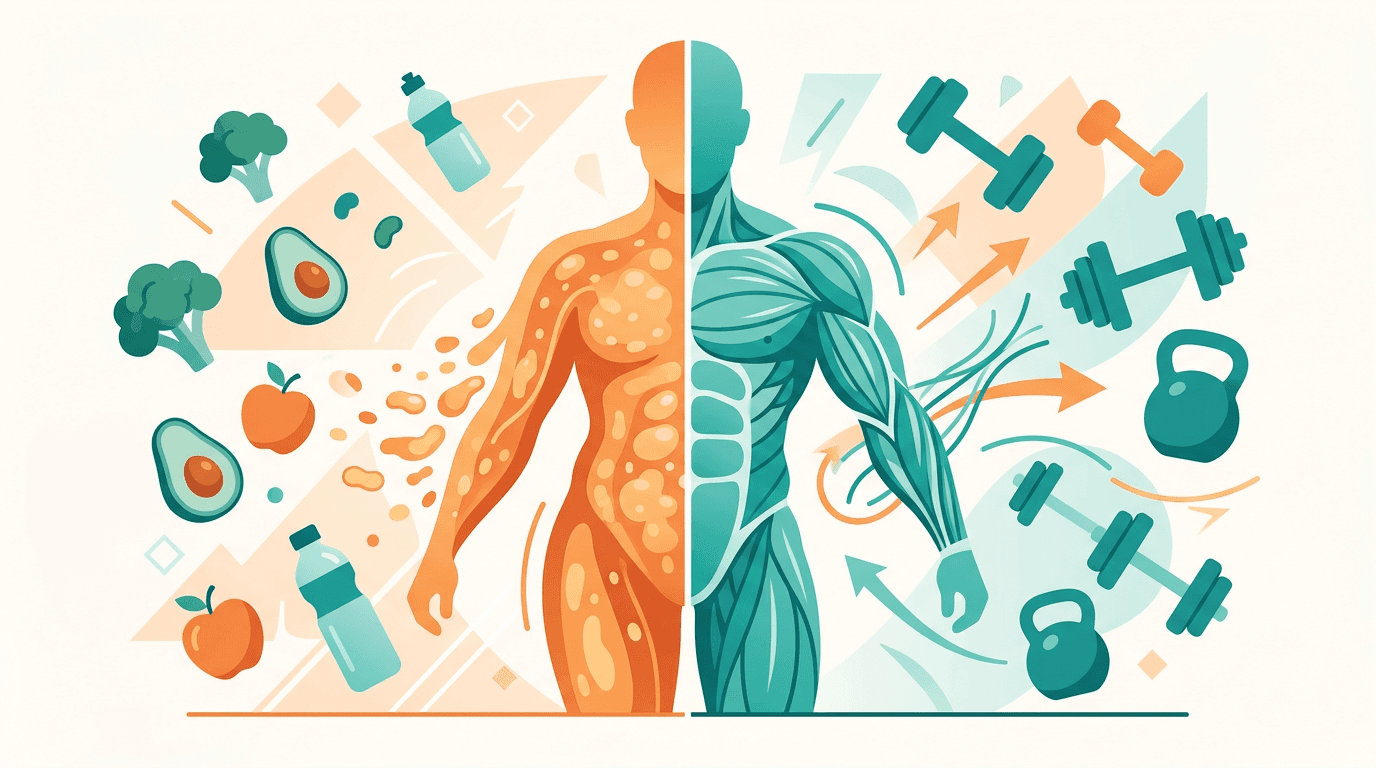
The fitness industry loves binary choices: you're either bulking or cutting. Eat big to build muscle, then diet hard to reveal it. Repeat forever. But there's a third option that most people overlook — body recomposition, where you lose fat and build muscle simultaneously. It's slower than a dedicated bulk or cut, and it requires more precision. But for most people who aren't competitive bodybuilders, it's the smarter approach.
What Is Body Recomposition?
Body recomposition (or "recomp") means changing your body composition — the ratio of fat to muscle — without necessarily changing your weight. The scale might not move for months, but the mirror tells a different story: clothes fit better, you look leaner, and your strength numbers go up.
Traditional approaches treat fat loss and muscle gain as separate phases:
| Approach | Goal | Calorie Target | Typical Duration |
|---|---|---|---|
| Bulk | Build muscle | Surplus (+300-500 cal) | 3-6 months |
| Cut | Lose fat | Deficit (-500-750 cal) | 2-4 months |
| Recomp | Both simultaneously | Near maintenance | Ongoing |
The reason recomp works is that fat loss and muscle gain are driven by different mechanisms. Fat loss requires a calorie deficit. Muscle gain requires progressive overload, adequate protein, and recovery. In certain conditions — especially for beginners, people returning from a training break, or anyone carrying significant body fat — you can achieve both at once.
Who Gets the Best Results from Recomp?
Body recomposition works for almost everyone, but some people see dramatically faster results:
Beginners — If you've never trained seriously, your muscles are primed for rapid growth (often called "newbie gains"). You can build muscle at a modest deficit because your body has so much untapped potential.
Detrained lifters — Took a year off from the gym? Muscle memory is real. Your body rebuilds lost muscle faster than it built it the first time, even in a slight deficit.
People with higher body fat — If you're above 25% body fat (men) or 35% (women), your body has ample stored energy to fuel muscle growth. The higher your body fat, the more aggressively you can deficit while still gaining muscle.
Intermediate lifters — Recomp still works, but progress is slower. Expect body composition changes over 6-12 months rather than weeks.
The one group that struggles with recomp: lean, advanced lifters. If you're already at 12% body fat with years of training, the margin is too thin — you'll need dedicated bulk/cut cycles to make meaningful progress.
Setting Your Calories for Recomp
The recomp sweet spot is eating at or slightly below your Total Daily Energy Expenditure (TDEE). Too large a deficit and you lose muscle. Too large a surplus and you gain fat.
Step 1: Estimate your TDEE.
Use a Calorie Calculator to find your maintenance calories. For a 30-year-old male, 80 kg, 178 cm, exercising 4x per week, the TDEE is approximately 2,700 calories.
Step 2: Set your target.
| Starting Point | Calorie Target | Rationale |
|---|---|---|
| Higher body fat (>20% men, >30% women) | TDEE minus 300-500 | Body has stored energy; moderate deficit still supports muscle growth |
| Moderate body fat (15-20% men, 25-30% women) | TDEE minus 100-300 | Gentle deficit; slower fat loss but protects muscle gains |
| Lower body fat (<15% men, <25% women) | TDEE to TDEE minus 100 | Near maintenance; recomp is slow but possible |
For our example (TDEE 2,700, moderate body fat): target 2,400-2,500 calories per day.
The mistake most people make is going too aggressive. A 700-calorie deficit is a cut, not a recomp. You'll lose weight — including muscle. The whole point of recomp is patience in exchange for body composition quality.
Macronutrient Breakdown for Recomp
Calories determine whether you gain or lose weight. Macros determine what you gain or lose.
Protein: The Non-Negotiable
Protein is the most critical macro for recomposition. Research consistently shows that higher protein intake preserves muscle during a deficit and supports growth during maintenance. The meta-analysis by Morton et al. (2018), published in the British Journal of Sports Medicine, found that 1.6g per kg of body weight per day maximized muscle protein synthesis, though benefits may extend up to 2.2g/kg for people in a deficit.
For recomp: aim for 1.8-2.2g of protein per kilogram of body weight.
Our 80 kg example: 144-176g protein per day.
Filling in Fats and Carbs
After protein, distribute remaining calories between fats and carbs:
- Fat: 0.7-1.0g per kg body weight (minimum for hormone health)
- Carbs: Whatever calories remain
Use a Macro Calculator to find your exact breakdown. For our 80 kg person at 2,450 calories:
| Macro | Grams | Calories | % of Total |
|---|---|---|---|
| Protein | 160g | 640 cal | 26% |
| Fat | 72g | 648 cal | 26% |
| Carbs | 290g | 1,162 cal | 48% |
Don't overthink the fat/carb ratio. Some people feel better with more carbs (better gym performance); others prefer more fat (better satiety). As long as protein is high and total calories are right, the split is personal preference.
Training for Recomposition
Nutrition sets the conditions for recomp. Training provides the stimulus. Without progressive overload, your body has no reason to build muscle — even with perfect macros.
The Essentials
Progressive overload. Every week, do slightly more than last week: heavier weight, an extra rep, an additional set. Your body builds muscle in response to demands it hasn't faced before.
Compound movements. Squats, deadlifts, bench press, overhead press, rows, pull-ups. These recruit the most muscle mass per exercise, which means more muscle-building stimulus per unit of time.
Volume. Research suggests 10-20 sets per muscle group per week for optimal hypertrophy. For recomp, start at the lower end (10-12 sets) and increase only if you're recovering well.
Frequency. Train each muscle group 2-3 times per week. A push/pull/legs split, upper/lower split, or full-body routine all work.
Sample Weekly Structure
| Day | Focus | Key Exercises |
|---|---|---|
| Monday | Upper Push | Bench press, overhead press, tricep work |
| Tuesday | Lower | Squats, Romanian deadlifts, leg press |
| Wednesday | Rest or cardio | |
| Thursday | Upper Pull | Rows, pull-ups, bicep work |
| Friday | Lower | Deadlifts, lunges, leg curls |
| Saturday | Optional upper | Weak points, accessories |
| Sunday | Rest |
Recovery is as important as the training itself. During a recomp (slight deficit or maintenance), your recovery capacity is lower than during a bulk. Sleep 7-9 hours. Manage stress. If you're constantly sore and your lifts are going down, you're training too hard for your calorie intake.
Tracking Progress Without the Scale
The scale is almost useless for tracking recomp. You might lose 3 pounds of fat and gain 3 pounds of muscle — the scale reads zero change, but your body is dramatically different.
Better progress markers:
Body measurements. Measure waist, hips, chest, and arms every 2-4 weeks. Waist going down while arms stay the same (or grow) is the recomp signal.
Progress photos. Take front, side, and back photos in consistent lighting every 4 weeks. Photo comparisons show changes the mirror can't because you see yourself daily and adapt to gradual changes.
Strength numbers. If your lifts are going up while your waist is going down, recomp is working. Track your key compound lifts.
Body fat percentage. Estimate your body fat with a Body Fat Calculator using the Navy method (waist, neck, and hip measurements). Track the trend over months, not individual readings.
How clothes fit. Less scientific, more practical. If your pants are looser in the waist but tighter in the thighs, you're doing something right.
Realistic Timelines
Recomp is not fast. Set expectations accordingly:
| Experience Level | Fat Loss Rate | Muscle Gain Rate | Noticeable Changes |
|---|---|---|---|
| Beginner | 1-2 lbs/month | 1-2 lbs/month | 2-3 months |
| Intermediate | 1-1.5 lbs/month | 0.5-1 lb/month | 4-6 months |
| Advanced | 0.5-1 lb/month | 0.25-0.5 lb/month | 6-12 months |
A realistic beginner scenario: over 6 months, you lose 8 pounds of fat and gain 8 pounds of muscle. Scale weight barely changes. Body fat drops from 22% to 17%. You look completely different, and your bench press went up 30%.
The people who fail at recomp fail because they expect cutting-speed fat loss. That's not what this is. This is building a better body composition without the misery of extreme diets or the body fat accumulation of aggressive bulks.
Common Recomp Mistakes
Eating too little. A 1,000-calorie deficit is a crash diet, not a recomp. You'll lose muscle and feel terrible. Keep the deficit modest: 200-400 calories below maintenance.
Skimping on protein. This is the one macro you can't negotiate. Below 1.6g/kg, muscle preservation drops significantly during a deficit. Hit your protein target every day, even if other macros fluctuate.
Neglecting sleep. Growth hormone is released during deep sleep. Chronic sleep deprivation impairs muscle recovery and increases cortisol (which promotes fat storage and muscle breakdown). Seven hours is the minimum; eight is better.
Program hopping. Stick with a training program for at least 8-12 weeks before changing. Progressive overload requires consistency — you can't progressively overload if you switch exercises every two weeks.
Obsessing over the scale. Weigh yourself if you want, but evaluate progress monthly using measurements, photos, and strength. Daily weight fluctuates 2-4 pounds from water alone.
Frequently Asked Questions
Can you really lose fat and build muscle at the same time?
Yes. Multiple studies confirm simultaneous fat loss and muscle gain, particularly in beginners, detrained individuals, and people with higher body fat percentages. The key requirements are adequate protein intake (1.8-2.2g/kg), progressive resistance training, and a modest calorie deficit or maintenance-level intake.
How much protein do I need for body recomposition?
Aim for 1.8-2.2 grams of protein per kilogram of body weight per day. For an 80 kg person, that's 144-176 grams daily. Higher protein intake during a deficit helps preserve existing muscle while supporting new muscle growth. Use a Macro Calculator to find your specific targets.
How long does body recomposition take?
Expect noticeable visual changes in 2-3 months for beginners and 4-6 months for intermediate lifters. Body recomposition is a gradual process — the scale may not change significantly, but measurements, photos, and strength numbers will show progress. Most people see meaningful transformation over a 6-12 month period.
Is recomp better than bulking and cutting?
For most non-competitive lifters, recomp is more sustainable and avoids the downsides of bulk/cut cycles (excessive fat gain during bulks, muscle loss during cuts). However, advanced lifters close to their genetic potential may need dedicated phases to make progress. Recomp is the better choice when you want steady improvement without dramatic weight swings.
Do I need to count calories for recomp?
Precise tracking helps, especially in the beginning, because the margin between "slight deficit" and "too much deficit" is narrow. Track for 4-6 weeks to build awareness of portion sizes, then you can relax into intuitive eating guided by progress metrics. At minimum, track protein — it's the one macro that can't be approximate.