
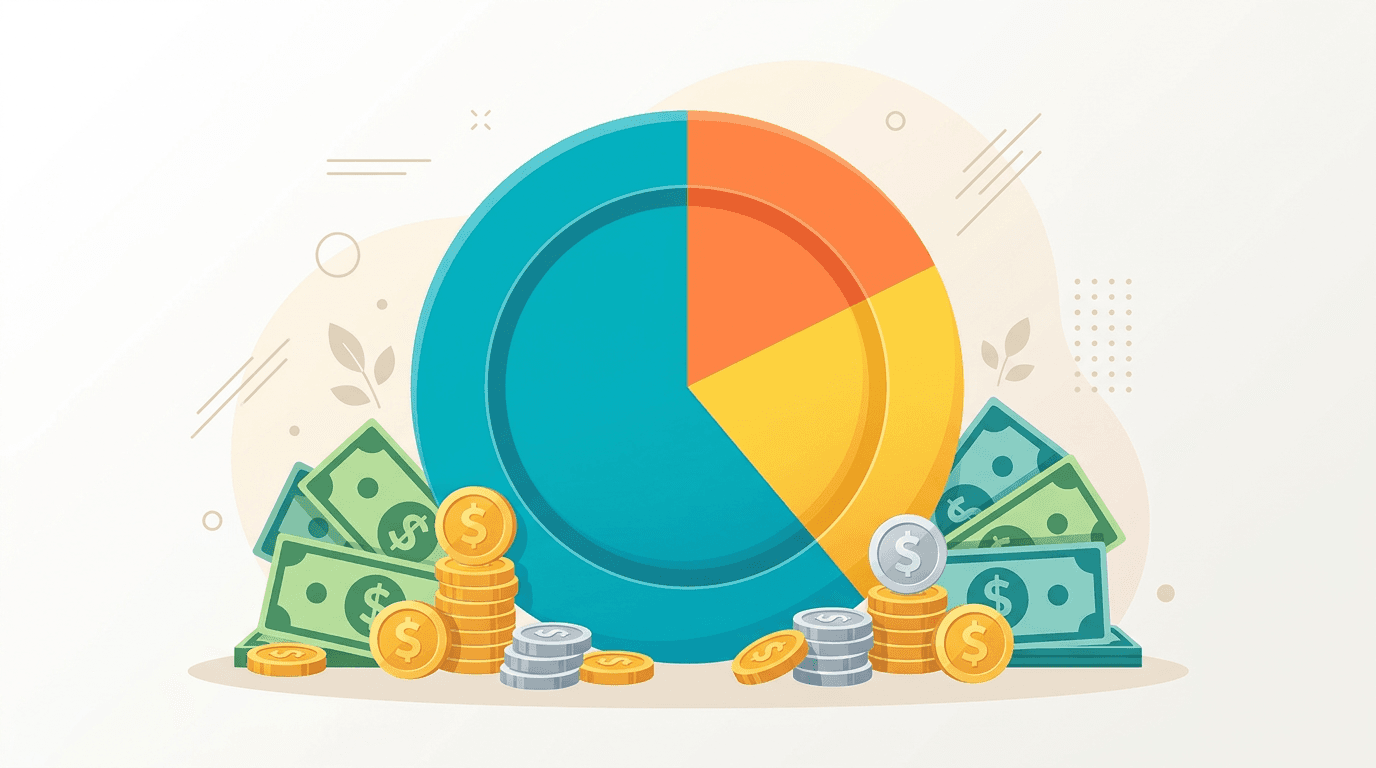
Most budgets die within two weeks. Not because people lack discipline — because the budget itself is too complicated. Tracking 47 spending categories on a spreadsheet that takes 20 minutes to update is a recipe for abandonment. The 50/30/20 rule takes the opposite approach: three buckets, one simple ratio, and enough flexibility that you can actually stick with it.
What Is the 50/30/20 Rule?
Senator Elizabeth Warren and her daughter Amelia Warren Tyagi introduced the 50/30/20 framework in their 2005 book All Your Worth: The Ultimate Lifetime Money Plan. The concept is straightforward: divide your after-tax income into three categories.
- 50% — Needs: Things you must pay for to survive and function. Rent or mortgage, utilities, groceries, health insurance, minimum debt payments, transportation to work.
- 30% — Wants: Everything you enjoy but could technically live without. Dining out, streaming subscriptions, hobbies, vacations, that third pair of running shoes.
- 20% — Savings & Debt Repayment: Money that builds your future. Emergency fund contributions, retirement accounts, extra debt payments beyond the minimum, investments.
The reason this framework works where others fail is its simplicity. You don't need to decide whether a $4 coffee is "dining" or "beverages" or "daily expenses." It's a want. Done. Move on.
How to Calculate Your After-Tax Income
The 50/30/20 rule operates on after-tax income, not your gross salary. This is the money that actually hits your bank account — what you have to work with after federal and state taxes, Social Security, and Medicare are deducted.
If you're a salaried employee, your after-tax income is your net pay from your paycheck. If you're self-employed, it's your income minus taxes and business expenses.
Here's how a $65,000 gross salary breaks down for a single filer in the US (2025 federal tax brackets):
| Component | Amount |
|---|---|
| Gross Salary | $65,000 |
| Federal Income Tax | ~$7,062 |
| Social Security (6.2%) | $4,030 |
| Medicare (1.45%) | $943 |
| After-Tax Income | ~$52,965 |
State taxes vary — a Texan keeps the full amount above, while a Californian loses another 4-6%. Use a Salary Calculator to find your exact after-tax income based on your filing status and state.
Your monthly after-tax income in this example: $4,414.
Breaking Down the Three Buckets
The 50% — Needs
Needs are non-negotiable expenses. If you skipped a payment and something bad would happen — eviction, repossession, loss of electricity — it's a need.
| Expense | Typical Range |
|---|---|
| Rent / Mortgage | $1,200 – $2,000 |
| Utilities (electric, water, gas, internet) | $150 – $300 |
| Groceries | $300 – $500 |
| Health Insurance | $200 – $500 |
| Car Payment + Insurance | $300 – $600 |
| Minimum Debt Payments | Varies |
| Phone Plan | $40 – $80 |
For our $4,414/month example, the needs budget is $2,207. If your needs exceed 50%, you have two options: increase your income or reduce your largest fixed costs (typically housing and transportation).
A common mistake is misclassifying wants as needs. Internet at home? That's a need if you work remotely. A premium 500 Mbps plan when 100 Mbps would work? The base service is a need; the upgrade is a want.
The 30% — Wants
Wants are the things that make life enjoyable. This category gets an unfairly bad reputation in personal finance circles. Spending on wants isn't irresponsible — it's the reason you work in the first place. The key is keeping it within bounds.
Common wants include:
- Restaurant meals and takeout
- Streaming services (Netflix, Spotify, etc.)
- Gym memberships beyond basic fitness
- Shopping for non-essential clothing
- Hobbies and entertainment
- Vacations and travel
- Upgraded phone plans or devices
For our example: $1,324/month on wants. That's roughly $330 per week, which is more than enough for a social life, hobbies, and occasional splurges without guilt.
The 20% — Savings and Debt Repayment
This bucket builds your financial future. It covers everything beyond minimum debt payments (minimums are needs).
Priority order for most people:
- Emergency fund — 3-6 months of expenses in a high-yield savings account
- 401(k) match — If your employer matches contributions, take the free money
- High-interest debt — Credit cards and personal loans above 7-8% interest
- Roth IRA or additional 401(k) — Max out tax-advantaged accounts
- Taxable investments — Brokerage account for goals beyond retirement
For our example: $883/month toward savings and debt repayment. Over a year, that's $10,596 — enough to build a solid emergency fund and make meaningful retirement contributions.
A Worked Example: $65,000 Salary
Let's put the full picture together. A single filer earning $65,000 gross, living in a state with no income tax.
Use a Tax Calculator to determine your exact federal tax liability. For this example:
| Category | Monthly Budget | Annual Budget | Examples |
|---|---|---|---|
| Needs (50%) | $2,207 | $26,483 | $1,400 rent, $200 utilities, $400 groceries, $50 phone, $157 remaining |
| Wants (30%) | $1,324 | $15,890 | $300 dining out, $50 subscriptions, $200 hobbies, $774 discretionary |
| Savings (20%) | $883 | $10,593 | $400 401(k), $250 emergency fund, $233 Roth IRA |
| Total | $4,414 | $52,965 |
The beauty of this breakdown is its flexibility within each bucket. You can spend your $1,324 wants budget on two nice dinners or twenty cheap ones — the rule doesn't care. It only constrains the total.
What if Your Numbers Don't Fit?
For many people, especially in high cost-of-living cities, the first attempt at 50/30/20 reveals that needs consume 60-70% of income. This isn't a failure — it's information. Here's how to adjust:
If needs exceed 50%: - Consider the 60/20/20 split as a temporary alternative - Look for the single biggest lever (usually housing or car payments) - Can you add a roommate? Refinance? Switch to public transit?
If you have significant debt: - Consider a 50/20/30 split — flipping wants and savings temporarily - Direct the extra 10% toward high-interest debt - Once debt is cleared, return to the standard ratio
If your income is high: - You probably don't need 30% on wants — a $90,000 after-tax income gives you $27,000/year in wants, which is more than most people need - Consider a 50/20/30 split with the extra going to investments
Alternatives to the 50/30/20 Rule
The 50/30/20 framework isn't the only option. Different financial situations call for different approaches.
| Method | Split | Best For | Downside |
|---|---|---|---|
| 50/30/20 | 50% needs, 30% wants, 20% savings | Most people, especially beginners | Needs may exceed 50% in expensive cities |
| 60/20/20 | 60% needs, 20% wants, 20% savings | High cost-of-living areas | Less room for enjoyment |
| 80/20 | 80% spending, 20% savings | People who hate tracking | No distinction between needs and wants |
| 70/20/10 | 70% spending, 20% savings, 10% giving | People who prioritize charitable giving | Lower savings rate |
| Zero-Based | Every dollar assigned a job | Detail-oriented planners, high debt | Time-consuming, easy to abandon |
| Pay Yourself First | Save first, spend the rest | People who struggle with discipline | Doesn't address overspending on needs |
The "best" method is the one you'll actually follow. If the 50/30/20 split feels too rigid, the 80/20 approach might work better — just save 20% and spend the rest however you want. If you're drowning in debt, zero-based budgeting gives you more control during the payoff period.
Common Mistakes to Avoid
Mistake #1: Using gross income instead of net. The 50/30/20 rule uses after-tax income. If you budget based on your $65,000 salary instead of your $52,965 take-home pay, your percentages will be off by roughly 18%.
Mistake #2: Counting minimum debt payments as savings. Minimum payments on credit cards and loans are needs — they're required. Only extra payments above the minimum count toward your 20% savings bucket.
Mistake #3: Being too strict with categories. A gym membership could be a need (doctor-prescribed exercise) or a want (you prefer the gym over free home workouts). Don't agonize over edge cases. Pick a category and move on.
Mistake #4: Ignoring irregular expenses. Car repairs, annual insurance premiums, holiday gifts — these blow up budgets because people forget to account for them. Divide annual irregular expenses by 12 and include them in your monthly needs or wants.
Mistake #5: Not adjusting as income changes. A raise means your dollar amounts change, but the percentages stay the same. Recalculate every time your income shifts significantly.
How to Start Today
Skip the apps and spreadsheets for now. Here's the five-minute version:
- Find your after-tax monthly income (check your last paycheck or use a Salary Calculator)
- Multiply by 0.50, 0.30, and 0.20
- List your current fixed expenses — do they fit in the 50%?
- Set up an automatic transfer for 20% to a savings account on payday
- Spend the remaining 30% however you want, guilt-free
The automatic transfer is the most important step. If the money leaves your checking account before you see it, the saving happens without willpower. That's the real advantage of the 50/30/20 system — it works with human psychology instead of against it.
Frequently Asked Questions
Does the 50/30/20 rule work for low incomes?
At very low incomes, needs often consume well over 50% of take-home pay. In that case, focus on two priorities: covering essential needs first, and saving whatever you can (even if it's 5% instead of 20%). The rule works better as a target to grow into as your income increases rather than a rigid framework when money is extremely tight.
Should I include rent or mortgage in the 50% needs category?
Yes. Housing is typically the largest single item in your needs bucket. If rent alone takes up 35-40% of your after-tax income, your total needs will likely exceed 50%. Financial advisors generally recommend keeping housing costs below 30% of gross income, which aligns well with the 50/30/20 framework.
What counts as savings — only cash in a savings account?
No. The 20% savings bucket includes emergency fund contributions, retirement account contributions (401k, IRA), extra debt payments above the minimum, and any investments in brokerage accounts. It's "money working for your future" rather than strictly cash savings.
Can I adjust the percentages?
Absolutely. The 50/30/20 split is a starting point, not a law. People in high-rent cities often use 60/20/20. Aggressive savers targeting early retirement might use 50/15/35. The percentages should reflect your reality and goals. The value is in having a framework at all.
How is the 50/30/20 rule different from zero-based budgeting?
The 50/30/20 rule groups spending into three broad categories and doesn't require tracking individual purchases. Zero-based budgeting assigns every dollar to a specific purpose before the month begins, requiring detailed tracking. The 50/30/20 rule is simpler and more forgiving; zero-based budgeting offers more control but demands more effort.